

The Biggest Obstacle for Hospitality Development Teams Is System Understanding
Hospitality software development is moving faster than ever.
Hotels are investing in digital guest experiences, mobile applications, loyalty platforms, self-service technologies, AI-driven personalization, and operational automation. At the same time, development teams are being asked to deliver new capabilities faster, support more integrations, and maintain reliability across increasingly complex technology environments.
For software development leaders, the challenge isn’t a lack of technology.
It’s understanding how all of that technology works together.
Further, as hospitality organizations continue to expand their technology ecosystems, many development teams are finding that the biggest obstacle to delivery isn’t writing code—it’s finding the information needed to make the right decisions.
The Growing Challenge of System Complexity
A modern hospitality technology environment may include a Property Management System (PMS), Revenue Management System (RMS), CRM, loyalty platform, booking engine, mobile applications, payment systems, guest messaging tools, business intelligence platforms, and dozens of third-party integrations.
And, each new system creates additional dependencies. Each integration introduces new business rules. Each enhancement adds another layer of complexity.
Unfortunately, the knowledge required to manage that complexity is rarely stored in one place.
Architectural decisions live in documents. Requirements are buried in tickets. Business logic exists in source code. Historical context often resides with a handful of senior developers and architects.
The result is a challenge many development leaders know all too well.
A seemingly simple change request can turn into days of investigation because no one has a complete picture of how systems, applications, and data flows are connected.
Recent industry research highlights the scope of the problem. According to Starfleet Research, only 24% of hotels report having fully integrated core systems, while many continue to operate with fragmented technologies and disconnected data sources.
For development teams, fragmentation creates real operational challenges:
- Longer onboarding times for new developers
- Increased dependency on key individuals
- More time spent researching impacts before making changes
- Higher risk of unintended consequences
- Slower delivery cycles
As systems become more interconnected, understanding the impact of change becomes just as important as making the change itself.
AI Is Accelerating Development But Not Understanding
At the same time, hospitality organizations are rapidly embracing artificial intelligence.
The potential benefits are significant. AI can help teams generate code, accelerate testing, improve documentation, and automate repetitive tasks.
But many hospitality organizations are discovering that successful AI adoption requires more than simply deploying AI tools.
According a recent article by Hospitality Upgrade:
- 62% of organizations cite a lack of AI expertise as a major challenge.
- 51% struggle with defining a clear AI strategy.
- 45% report integration challenges related to AI initiatives.
Another industry report by Hospitality Net found that while 86% of European hotel chains are already using AI in some capacity, 80% still lack a formal AI strategy.
These findings reveal an important reality: AI can help developers move faster, but it does not automatically understand years of architectural decisions, business rules, integrations, operational workflows, and organizational knowledge.
In many organizations, development speed is increasing while system understanding is becoming harder to maintain.
That creates risk.
Without sufficient context, teams can introduce technical debt more quickly, make decisions based on incomplete information, and become increasingly dependent on a small number of individuals who understand how everything works.
- more manual validation,
- longer release cycles,
- broader testing than necessary,
- increased dependence on a few institutional experts, and
- more hesitation around innovation.
Why Context Has Become a Strategic Asset
For hospitality software leaders, one of the most valuable assets is no longer just code.
It’s context.
Understanding why decisions were made, how systems interact, which dependencies exist, and what risks may be introduced by change has become essential to delivering software predictably.
The challenge is that context is often fragmented across:
- Source code repositories
- Requirements documents
- Jira tickets
- Architecture diagrams
- Internal documentation
- Team conversations
- Individual knowledge
Finding answers often requires searching through multiple systems and involving multiple people.
Thus, that approach becomes increasingly difficult as organizations scale.
How IntelLayer™ Helps Create Shared Understanding
This is where an AI-powered intelligence engine, such as IntelLayer™, can provide significant value.
Rather than creating another repository of information, IntelLayer continuously connects the information development teams already use every day, including source code, requirements, tickets, architecture, dependencies, and delivery history.
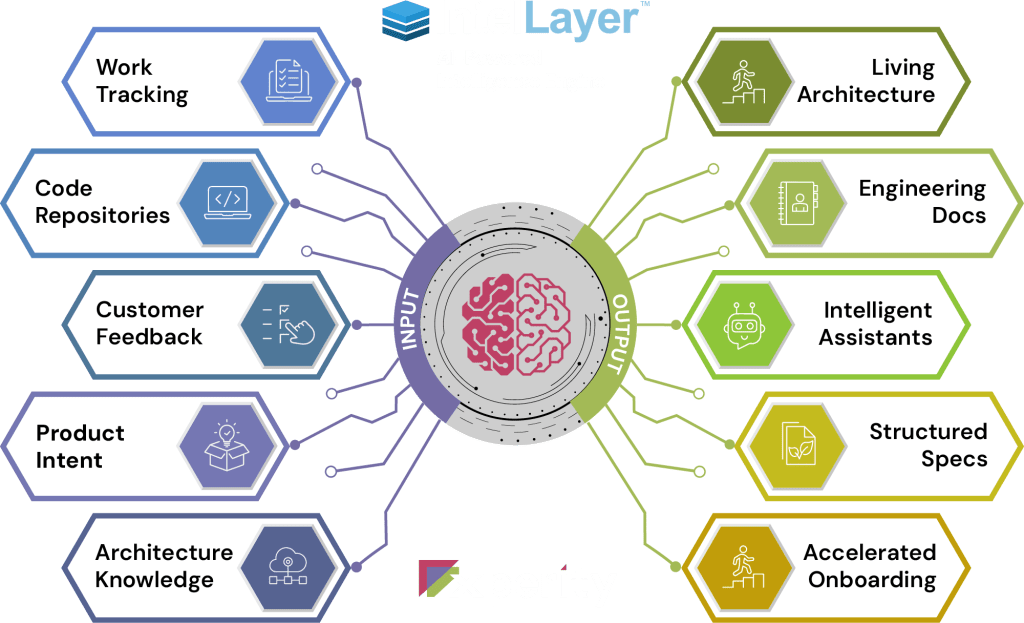
The result is a shared understanding of how software systems are built, how they interact, and how changes impact the broader environment.
For hospitality development leaders, this means:
Faster Impact Analysis
Developers can quickly understand what systems, services, and workflows may be affected by a proposed change.
Reduced Dependency on Tribal Knowledge
Critical knowledge becomes accessible across the organization rather than residing with a few experienced team members.
Faster Onboarding
New engineers can understand architecture, dependencies, and historical decisions more quickly.
More Effective AI Adoption
AI-generated recommendations and code can be evaluated against organizational context, architectural standards, and business requirements.
Greater Delivery Predictability
Teams spend less time searching for information and more time delivering business value.
The Future Belongs to Teams That Understand Their Systems
The hospitality industry will continue investing in AI, automation, personalization, and digital transformation.
Those investments will create tremendous opportunities, but they will also increase system complexity.
The organizations that succeed will not necessarily be the ones with the most technology.
They will be the ones that can effectively manage the knowledge and context behind that technology.
As development teams are asked to move faster, support more systems, and adopt AI-driven workflows, shared understanding becomes a competitive advantage.
The biggest challenge isn’t building software, it’s understanding it.
And the teams that solve that challenge will be the ones best positioned to innovate, scale, and deliver with confidence.
Those that do not may find themselves generating more code, more data, and more complexity without gaining the visibility needed to manage it.
The next competitive advantage in hospitality technology may not be AI itself.
It may be the ability to give AI—and the teams using it—the context needed to make better decisions.
“Marriott is undertaking a multi-year transformation to support rapid brand expansion, increasing operational complexity, and a global customer base of more than 400 million.”
Prashant Gaba, VP, Global Data Strategy, Data Science & Activations, Marriott International
Ready to Improve Software Delivery Predictability?
If your development teams are spending too much time searching for answers, rebuilding context, or assessing the impact of change, it may be time to take a different approach.
Xperity helps hospitality organizations improve software delivery through a combination of expert engineering, AI-enabled delivery practices, and IntelLayer™ Delivery Intelligence. By connecting the knowledge, decisions, architecture, and delivery signals that already exist across your SDLC, we help teams reduce complexity, accelerate onboarding, improve visibility, and deliver with greater confidence.
Contact us to learn how IntelLayer can help your organization create shared system understanding, adopt AI more effectively, and improve software delivery predictability.