
Explore six medical imaging software challenges and how they affect software delivery.
A seemingly small change to medical imaging software can have delivery consequences far beyond the code being modified.
Consider an update to an AI-powered radiology worklist. The development task may appear straightforward, but the change could affect routing rules, reporting workflows, interface behavior, result timing, and customer-specific configurations. What begins as a relatively contained engineering task can quickly become a much larger investigation.
For CTOs, engineering leaders, and product executives building imaging AI, picture archiving and communication systems (PACS), radiology information systems (RIS), radiology workflow platforms, cloud diagnostics, and medical device software, the challenge isn’t simply delivering new functionality. It’s understanding what that functionality could affect before committing to development.
That challenge becomes more difficult as products evolve. Architectures change, engineering teams expand, integrations multiply, and the reasoning behind earlier technical decisions becomes harder to find.
The real question is whether your team understands enough about the existing system to make informed decisions about what comes next.
Answering that question requires more than source-code access or documentation searches. Teams need to understand how architecture, implementation, requirements, engineering decisions, and product behavior relate to one another.
Six areas where that understanding can make a meaningful difference in medical imaging software delivery.
1. Understand Software Dependencies Before Committing to a Release
One of the most persistent challenges in established software products is determining the full scope of a proposed change.
A feature request may involve a single component, but its behavior could depend on multiple services, interfaces, configurations, and workflows.
Imagine migrating an image-processing service to a new cloud environment. Before development begins, the engineering team may need to determine:
- Which services depend on the existing component?
- How are images retrieved, processed, and delivered?
- Which authentication and authorization mechanisms are involved?
- What happens when processing fails or a service becomes unavailable?
- Which customer-specific configurations could be affected?
- What regression testing will be needed?
The difficulty isn’t always writing the new code. It’s discovering the dependencies and assumptions that determine whether the change will work as intended.
When that knowledge is scattered across repositories, documentation, engineering tickets, and individual team members, estimating the work becomes more difficult.
A better approach starts with understanding the existing system before defining the scope of the change.
Connecting architecture, implementation, requirements, and previous decisions gives engineering leaders a stronger foundation for assessing complexity, identifying uncertainty, and planning development and testing.
2. Make PACS and RIS Integration Part of Product Acceptance
Medical imaging software rarely operates in isolation.
Imaging AI applications, reporting systems, PACS, RIS, and cloud services must exchange information reliably within clinical and operational workflows.
A feature can work correctly in its own environment yet fail to deliver the intended benefit when integrated into a customer’s workflow.
Research reported by RSNA illustrates why integration timing matters. Investigators examined nearly 400,000 AI-processed imaging studies across 20 Swiss centers. Although the report described turnaround-time improvements, only one in five AI results was available before reporting. [1]
The findings reflect one network’s experience rather than a universal industry benchmark. Nevertheless, they illustrate an important engineering consideration: successful processing does not necessarily mean information reaches its users at the right time.
For imaging AI and radiology workflow vendors, integration acceptance should consider questions such as:
- Where does the result appear in the clinical workflow?
- Is it available when the user needs it?
- How are incomplete or delayed results handled?
- What happens when an interface fails?
- Which upstream and downstream systems depend on the integration?
A cross-sector roundtable published in Radiology: Artificial Intelligence also identified infrastructure constraints and fragmented priorities among AI implementation challenges. [2]
These issues extend beyond individual software components.
Engineering teams need to connect product requirements, interface behavior, system dependencies, and customer expectations when defining acceptance criteria.
For technology leaders, integration success should be measured by how the software operates within the intended workflow—not merely whether an interface passes a technical test.
3. Keep Requirements, Implementation, and Verification Evidence Connected
As medical imaging software evolves, maintaining traceability between requirements, implementation, tests, and engineering decisions becomes increasingly important.
Consider a requirement that changes during development.
Can the team quickly determine which components implement that requirement? Which tests provide relevant verification evidence? Which earlier design decisions might need to be reconsidered?
If answering those questions requires manually reconstructing information across disconnected systems, even a relatively small modification can demand significant investigation.
For software functions regulated as medical devices, this challenge has additional significance.
FDA guidance identifies documentation supporting its evaluation of device software safety and effectiveness. The FDA explains that this information is typically generated through development, verification, and design validation activities. [3]
The engineering priority is to maintain useful connections between the information created during those activities.
A practical approach includes:
- Keeping requirements associated with the implementation that supports them.
- Maintaining visibility into relevant tests and verification evidence.
- Preserving the reasoning behind significant technical decisions.
- Identifying gaps or inconsistencies before they become release-review problems.
Connected engineering knowledge can help teams investigate these relationships without relying entirely on manual searches or individual recollections.
However, engineering intelligence does not replace controlled quality records, formal evidence acceptance, or regulatory decisions. Those responsibilities remain within the manufacturer’s established processes, and regulatory requirements depend on the specific software function.
The opportunity is to make relevant engineering knowledge easier to discover, understand, and use throughout development.
See How Connected Context Changes the Investigation
When code, architecture, requirements, documentation, and engineering decisions are connected, teams can investigate dependencies and potential change impact with more context.
Watch the 2-Minute IntelLayer Demo →4. Assess Cybersecurity Changes Across the Product
A cybersecurity update is rarely just a matter of modifying or replacing a vulnerable component.
Before releasing a remediation, engineering teams may need to determine which services use the affected component, which configurations could be impacted, and what verification is needed afterward.
The FDA’s February 2026 final cybersecurity guidance addresses device design, labeling, and premarket documentation for devices with cybersecurity risk. [4]
For medical imaging software organizations, the engineering challenge is understanding the consequences of security-related changes across an interconnected product.
Consider a vulnerability affecting a shared service or third-party dependency.
The investigation may involve several questions:
- Where is the affected component used?
- Which services and integrations depend on it?
- Could remediation alter existing behavior?
- What compatibility or deployment issues should be considered?
- Which regression tests are necessary before release?
Dependency information helps define the scope of the investigation.
Vulnerability detection, threat assessment, and security testing remain separate activities that provide their own evidence. Engineering teams need to bring these inputs together when evaluating remediation options.
Understanding product dependencies helps organizations approach security updates as controlled engineering changes rather than isolated fixes.
5. Plan Imaging AI Updates Beyond the Model
For companies building imaging AI products, updating a model may be only one part of the engineering work.
A proposed change can affect input assumptions, preprocessing, interfaces, result handling, compatibility, and the activities required to evaluate the updated product.
The FDA’s August 2025 final guidance on predetermined change control plans (PCCPs) recommends describing planned AI device modifications, the methodology for developing and validating them, and an assessment of their impact. Where authorized, a PCCP covers specified modifications within its scope. [5]
The broader engineering lesson applies beyond any individual regulatory mechanism.
Before an AI-related update proceeds, teams should establish:
- What is changing, and what is not?
- Which components and interfaces depend on the existing behavior?
- What assumptions about input data or result handling may be affected?
- Which verification and validation activities are appropriate?
- Who is responsible for evaluating the proposed changes?
These questions help establish clear boundaries around the work.
They also make it easier to coordinate engineering, product, quality, clinical, and regulatory specialists when their involvement is required.
The goal is not simply to update an AI capability. It is to understand how that update affects the surrounding software product.
A related but distinct consideration is the growing use of AI within software engineering itself. Organizations adopting AI-assisted development should define approved information access, review requirements, and engineering accountability. AI-generated outputs still require appropriate human evaluation, and responsibility for architecture, quality, and release decisions remains with the organization.
6. Preserve System Knowledge During Modernization
Many established medical imaging products contain years of accumulated engineering knowledge.
Some of that knowledge is captured in source code and documentation. Some exists in historical decisions, customer-specific behavior, integration exceptions, and the experience of engineers who have worked on the product over time.
Modernization becomes more difficult when the reasoning behind the existing system is no longer readily accessible.
Consider an established PACS/RIS platform moving selected capabilities to a modern architecture.
Before replacing an older component, the team may need to understand:
- Why was the original component designed this way?
- Which customer requirements shaped its behavior?
- Which exceptions are intentional rather than defects?
- What systems and workflows depend on it?
- Which previous decisions remain relevant?
- What evidence will demonstrate that the replacement behaves as intended?
Without this context, modernization can become an exercise in rediscovering the product.
That investigation consumes engineering capacity and makes it harder to establish reliable estimates, plan migrations, and define acceptance criteria.
A more deliberate approach starts by understanding the existing system, identifying critical relationships, and defining a bounded modernization initiative.
For companies with long-lived imaging platforms, preserving and making system knowledge accessible can also improve collaboration between internal engineers and external development partners.
Modernization should not require losing the knowledge that made the original product work.
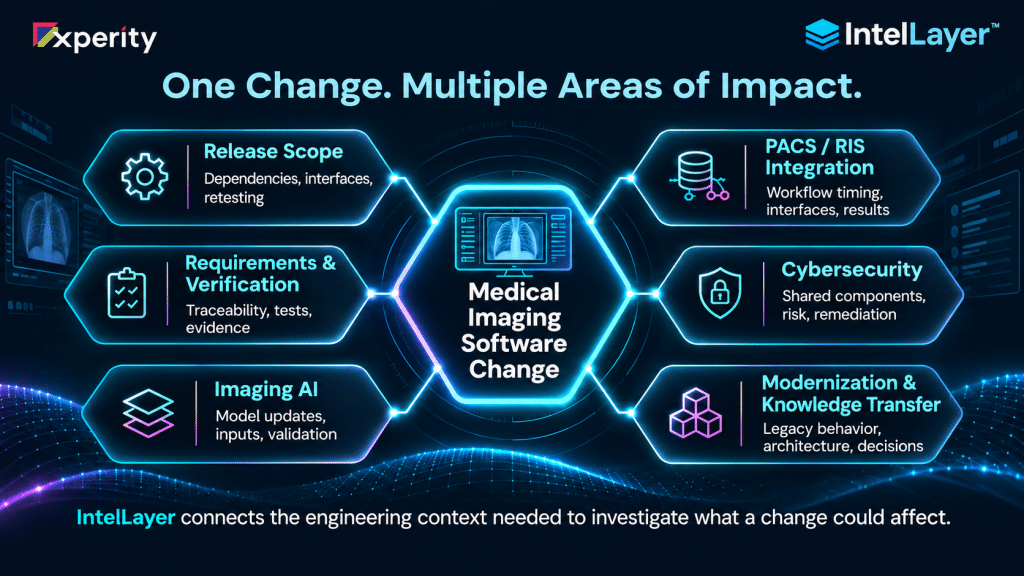
Six Questions to Ask Before Changing Medical Imaging Software
A ticket tells you what someone requested. To estimate the work and plan testing, teams also need to understand how the software works today, why it was built that way, and what the change could affect.
IntelLayer™, Xperity’s Delivery Intelligence Layer, connects code, architecture, requirements, documentation, and engineering decisions so engineers can investigate six practical questions before committing resources or setting a release date.
1. Release Scope
Which services, interfaces, and customer configurations could this change affect, and what will we need to retest?
IntelLayer helps engineers trace dependencies across components and configurations so they can refine estimates and prioritize regression testing.
2. PACS and RIS Integration
Will the AI result reach the radiologist before reporting, and what happens if it arrives late or the interface fails?
IntelLayer helps engineers trace the path a result takes across systems and compare it with workflow requirements. That context helps teams define acceptance tests for timing, delays, and failures.
3. Requirements and Verification
If this requirement changes, can we find the code that implements it, the tests that verify it, and the design decisions we may need to revisit?
IntelLayer helps teams find related code, tests, and design decisions in connected sources so they can spot gaps and decide what needs further verification.
4. Cybersecurity Remediation
If we patch this shared component, which services, integrations, and deployments need review before rollout?
Once the affected component is known, IntelLayer helps engineers trace where it’s used so they can scope the fix and identify which behaviors to retest.
5. Imaging AI Updates
If we update the model, which assumptions about image inputs, preprocessing, or result handling need review, and what will we need to verify or validate?
IntelLayer helps teams see how the model fits into the surrounding workflow, from preprocessing to result handling. Engineering, quality, and clinical teams can use that context to focus their reviews and define what evidence they need.
6. Modernization and Knowledge Transfer
Before we replace a legacy component, can the team explain which behaviors and customer-specific exceptions it must preserve and why they exist?
IntelLayer helps engineers find the requirements and past decisions behind those behaviors. That gives existing and incoming team members a shared basis for planning an incremental migration and agreeing on acceptance criteria.
IntelLayer supports engineering investigation and planning. The manufacturer retains responsibility for controlled quality records, formal verification and validation, regulatory decisions, and release authorization.
Put That Knowledge to Work With Xperity
Xperity’s engineering teams use that context to scope, design, build, integrate, and test software changes within your product and delivery requirements. As work progresses, they use the architecture and decisions behind the existing system to guide implementation and testing. During modernization, that same context helps teams preserve critical behavior and the reasoning behind it.
Start with one change already on your roadmap—a release, PACS/RIS integration, model update, or legacy migration. Define what your team needs to know before development begins and how difficult those answers are to find today. Then evaluate whether IntelLayer can help clarify scope, surface dependencies, and focus testing.
Have a change in mind?
Schedule a technical discussion with Xperity. We’ll talk through what the change could affect beyond the code and what your team needs to understand before development begins.
Know what exists. Understand why. Anticipate the impact of change.
Sources
- RSNA Daily Bulletin, “Swiss Study Reveals Real-World AI Adoption Patterns Across Radiology Network” , December 5, 2025.
- Towbin AJ, Kim W, Kottler N, et al. “Bridging Industry and Academia: Proceedings from the 2025 Academy Roundtable on AI Implementation in Medical Imaging” . Radiology: Artificial Intelligence, May 6, 2026.
- FDA, Content of Premarket Submissions for Device Software Functions , June 2023.
- FDA, Cybersecurity in Medical Devices: Quality Management System Considerations and Content of Premarket Submissions , February 2026.
- FDA, Marketing Submission Recommendations for a Predetermined Change Control Plan for Artificial Intelligence-Enabled Device Software Functions , August 2025.